
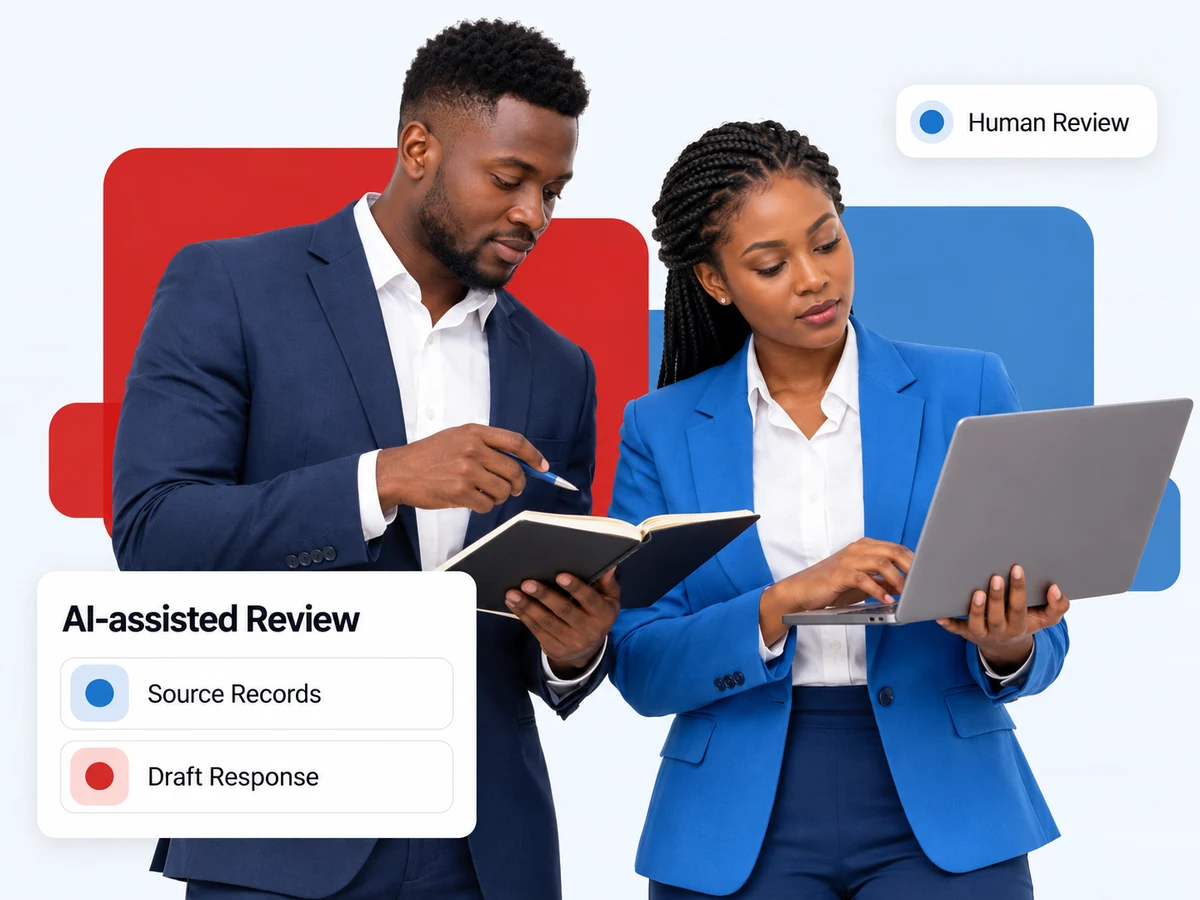
Planning & implementation decisions
When should you use an AI agent instead of rules automation?
Use rules for predictable decisions with explicit inputs. Consider AI for interpreting variable documents or language, with evaluation and permission boundaries. An agent that can choose actions needs tighter controls than a system that only drafts a response.
| Approach | Good fit | Boundary |
|---|---|---|
| Rules workflow | Fixed validation and approval routing | Unexpected inputs need an explicit exception path |
| AI-assisted task | Drafting or classification from variable documents | Validate against source records; allow correction |
| Agent with tools | Bounded multi-step work across approved systems | Limit actions and require consequential-action approval |
- Step 1 →
Retrieve
Enforce user and record permissions before retrieval.
- Step 2 →
Draft and validate
Return supporting references and check required fields.
- Step 3 →
Approve and act
An authorized person approves consequential changes.
- Step 4
Observe
Record outcomes, corrections and recoverable failures.
Exception & recovery path
Insufficient evidence, permission mismatch or failed validation → no action → human review. Provider outage falls back to a documented manual process.
What does a controlled AI workflow look like?
Authenticate the user, retrieve only authorized records, generate a draft with source references, validate it and request approval before consequential actions. Keep tool permissions scoped to the task; retrieved documents are data, not instructions that can grant new access.
How should an AI pilot be evaluated?
Create a representative, authorized test set with expected outcomes, including missing records, conflicting sources and attempted permission bypass. Compare against the current process and a rules-only baseline. Record correct answers, unsupported claims, refusals, staff corrections, latency and cost per completed task.
What happens when the answer is uncertain?
Require the system to show missing or conflicting evidence and route the task to a person. Test refusal and escalation as successful outcomes where appropriate. Do not let an unverified model response modify financial or operational records.
What changes AI implementation cost?
Data preparation, integrations, evaluation, reviewer time and ongoing model usage matter alongside interface development. Agree retention, provider data handling, monitoring and rollback before a pilot. Expand only after observed results meet task-specific acceptance criteria.
Take this into your project discussion
- Define one bounded task and a non-AI baseline.
- Prepare representative normal, ambiguous and adversarial cases.
- Set correctness, escalation, latency and cost criteria before testing.
- Verify permissions and approval gates independently of the model.
- Document monitoring, retention and rollback owners.
Planning content reviewed . Confirm current provider requirements and project-specific assumptions before implementation.
Turn Operational Data Into Useful Next Steps
Payments, service requests, maintenance records and financial reports tell different parts of the same story. Teams need a way to ask questions across those records, spot issues and follow through without repeating the same manual work.
We build AI-assisted workflows around approved business data and supported integrations. An assistant can help retrieve information, explain a pattern or prepare a report; predictable tasks can run through conventional automation. The approach starts with the work your team needs to complete.
Where We Are Building AI Into Our Platforms
Our current development direction includes AI-assisted workflows for SpotLetting and CountyERP. The examples below describe what we are building toward, not features already released or verified deployment results. Availability and scope will be confirmed for each implementation.
Property Operations: SpotLetting
We are building an AI-assisted property management and marketplace platform for Kenya. The planned assistant will work across property, tenant, payment, maintenance and financial data so landlords and property managers can understand their portfolios and act on outstanding work.
- Rent collection and reconciliation: Help match payment records to tenant accounts, surface unmatched receipts and prepare exceptions for finance staff to review.
- Tenant communication: Draft replies and follow-ups using approved account information, with review before sensitive messages are sent.
- Maintenance: Summarize reported issues, help prioritize requests and highlight jobs waiting for action.
- Property listings: Help prepare listing descriptions from verified property details and identify missing information before a listing goes live.
- Financial reporting: Prepare draft collection, arrears and expense summaries with references to the underlying records.
- Portfolio analytics: Answer operational questions and surface changes in occupancy, outstanding balances and maintenance activity.
A property manager might ask, “Which accounts have unmatched payments, and which maintenance requests still need follow-up?” The intended workflow is to retrieve the relevant records, prepare a review list and let the manager decide what happens next.
County Operations: CountyERP
CountyERP is being built for the operational needs of Kenya’s 47 county governments. This describes the platform’s intended market, not a claim of deployment in all 47 counties. Planned AI assistance will help authorized officers understand county data, prepare analysis and manage day-to-day work.
- Revenue collection: Surface unusual collection patterns, outstanding items and possible revenue opportunities for investigation.
- Financial management: Help officers find and explain financial records, compare reporting periods and review reconciliation exceptions.
- Budgeting: Prepare comparisons between budgets and recorded activity, with source records available for review.
- Reporting and analysis: Draft routine operational and financial summaries from authorized data instead of assembling every report manually.
- Audit readiness: Help locate supporting records, organize evidence and identify gaps requiring officer follow-up.
- Service delivery: Summarize requests, identify queues or delays and route matters to the responsible teams for action.
An officer might ask, “Which revenue streams differ from the expected pattern, and what records should we review?” The assistant should help assemble the evidence and explain the comparison. An unusual pattern is a reason to investigate, not proof of wrongdoing.
Connected to Your Systems. Controlled by Your Team.
An AI assistant should only access the information and tools permitted for its role. We design integrations around data ownership, access rights, traceable source records and the decisions that must remain with people.
A typical workflow receives a question or event, retrieves authorized records, prepares a draft answer or proposed action, then requests approval where needed. Activity logs, validation and exception handling help staff understand what happened and correct mistakes.
Payment adjustments, financial approvals, consequential tenant communications and government decisions need appropriate human authorization. Missing or conflicting information should be surfaced for review. AI-generated answers and reports can be wrong and must be checked against their sources.
AI Capabilities for Your Organization
Agents and Operational Assistants
Develop assistants for staff questions, document research, request triage and task preparation using approved business information.
Workflow Automation
Connect repeatable steps such as data extraction, approval routing, reminders, status updates and reporting. Use rules where the process is predictable and AI where interpretation is useful.
AI and Systems Integration
Connect compatible ERPs, CRMs, websites, databases, payment records and communication channels. Confirm API access, permissions and data quality before choosing the integration approach.
Custom AI Applications
Build document search, classification, information extraction and reporting assistance into an existing application or a new system. These are development services, not separate off-the-shelf products.
Start With One Workflow You Can Evaluate
- Define the task: Identify the users, current process, available records and decisions that need human approval.
- Check the foundations: Review data quality, integration access, privacy requirements and access controls.
- Build a focused pilot: Test a bounded task with representative, appropriately authorized data before expanding its responsibilities.
- Evaluate the results: Check factual accuracy, source traceability, permission boundaries, exception handling and usefulness to staff.
- Deploy and improve: Agree monitoring, usage costs, support, escalation and a way to measure whether the workflow improves daily work.
Useful measures might include time spent preparing a report, the proportion of drafts requiring correction or the number of unresolved exceptions. Agree the baseline and evaluation method before setting targets; the examples on this page are not promises of savings.
Frequently asked questions
Are these AI features already available in SpotLetting and CountyERP?
The workflows described here are in development. Confirm current availability, supported data sources and implementation scope with our team before relying on a particular capability.
Can AI work with our existing software?
Where compatible APIs, data access and permissions exist, an assistant or automated workflow can connect to existing systems. We review the workflow and integration constraints before recommending an approach.
Will the AI make financial or government decisions on its own?
Consequential decisions remain with authorized people. The intended role of AI is to prepare information, surface exceptions and propose next steps within defined permissions and approval controls.
How do you check the quality of an AI workflow?
We plan evaluations around realistic tasks, source accuracy, permission boundaries, missing data and exceptions. A focused pilot lets users review outputs before responsibilities are expanded.
What should we include in an AI project enquiry?
Describe the workflow, who uses it, the systems and records involved, and what a useful result would look like. Mention any approvals or sensitive data involved, but do not send private operational records through the contact form.